Posts

A Song Answering a Song

I recently heard two songs that were in a conversation with earlier songs.  There are plenty of self-referential songs. Many love songs lament the fact that despite the deeply felt emotion of the singer, which feels original and new, the singer is aware of how difficult it is to say, "I love you," in an original way.  But I'm taking about something different. I'm talking about a song that puts new words to an older version to directly answer that version. I think the first one I was aware of was "I can buy myself flowers" riposte to the breakup song in which the dude regrets not buying his lady love more shrubbery, which clearly would have had a deciding weight in their relationship's length. In the new version, the lady insists on doing her own gardening.  Then there is another "yes, but have you heard my side of the story," song, in which a male lead replies, point for point, to Taylor Swift's ten minute version of "ALL TOO WELL....
But Is It Art?

Every day I listen to (or even read) opinion pieces on AI art, opposing or defending.  It always reminds me of the Kipling poem.  Kipling, by the way, in this same poem, came up with quite the most interesting take on the Fall of Babel as I've seen. They builded a tower to shiver the sky and wrench the stars apart, Till the Devil grunted behind the bricks: "It's striking, but is it Art?" The stone was dropped by the quarry-side, and the idle derrick swung, While each man talked of the aims of art, and each in an alien tongue. Yes, that's right. The entire Tower of Babel was brought down by art critics. We should add a verse for today: They taught the engines brush and pen, and fed them hues and lore, And bade them paint the birth of gods, and build new myths once more. And some cried, “Cold!” and others, “Cool!”—and argued from the heart. While the Devil prompted them,  “It’s AI… but is it Art?”

Update on The Unfinished Song

It's not unreasonable to assume that anything which has taken too long already will never be completed at all. This is certainly the point of view of my children regarding my progress on my main series The Unfinished Song. I can see their point of view; after all, I've been working on this story for longer than they've been alive. They have cheerfully told me that they expect the completion of my epic around the same year we establish a colony on Mars. A colleague of mine also used me as an example of what NOT to do as a writer. She explained that I'd taken so long to finish my series, that although I'd had an audience once, it had frittered away and no one was interested any more. Despite that, the greatest journey is finished only step after step, whether the steps are slow or not, and whether or not the traveller becomes frequently lost or lodged for a long time elsewhere. So although I've also started (and yes, even completed) other series since I started Th...

Are People Reading Less? Are we all morons now?

Have we become a morass of ignorant, illiterate morons?  For most people this question would be a no-brainer (forgive the pun),  Book reading overall is supposedly in decline, but does that mean? Less than half of US adults read even a book a year (48% in 2022 rather than 54% in 2012), according to one survey, reported in Publisher’s Weekly. (Link:  https://www.publishersweekly.com/pw/newsbrief/index.html?record=4377  ) But, weirdly, that  isn’t necessarily because fewer people are reading at all. The raw number of those who read at all seems to be stable. The problem is that Whales have become Less Whaley. What I mean is that among readers, some are Whales and some are Minnows. If you read one piddling book a year, sorry, Minnows. If you read 15, you’re a Whale. If you read a book a week, I love you. The Whales getting less Whaley means that fewer people read more than 10 books per year, dropping from 35% in 2016 to 27% in 2021 . Americans read an average of 12...

Misque Press

 My publisher Misque Press has a new website.  Although I don’t have time for blogging much, I’m going to leave this blog up (oddly, it gets a fair amount of traffic) but I’m like to direct anyone interested in my books over to Misque Press .

Who Obsesses Over Rome...

Image
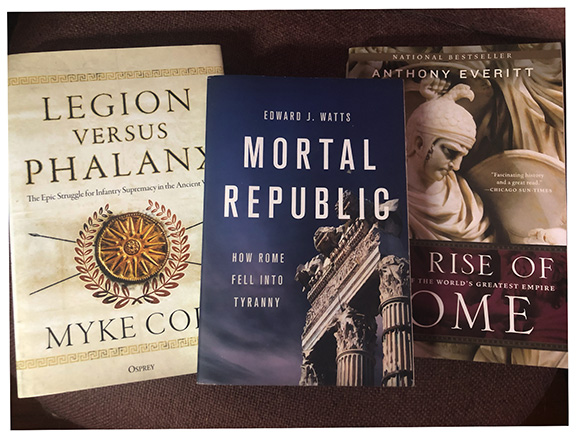
  Have you heard the latest meme going around, in which girlfriends and wives ask their romantic partners how often they think about Rome... and are shocked by the answers! Bizarrely, a lot of guys think about Rome once or twice a month, or a week, or even multiple times in a day! Which is weird, because I thought only fantasy novelists like me did that! Yeah, I do think about Rome quite often. Not so much the Roman Empire, but the Roman Republic. Why did it fall into tyranny? Are there analogies to our current situation? When did the first tyrant appear in the Roman Republic and how did his example make it easier for Caesar to take over as a permanent dictator eighty years later? (Whoops, I gave away the answer there.) And sometimes I do think about the Roman Empire too, particularly when I'm researching history's worst and craziest dictators, like Nero and Caligula, to see if I can find models for villains in my stories. And when I'm researching battle, of course, I alw...

How Does Fiction Reading Influence Empathy?

Image
  Last week, I discussed some fascinating questions regarding Empathy, Fiction and Imagination .  Those essays were theoretical, not empirical. I thought it would be interesting to see if there is any empirical evidence that reading fiction increases one's empathy or kindness. (What the lab shrinks like to call "prosocial behavior," as opposed to "anti-social behavior.")  I found a plethora of evidence that it does. Am I surprised? Not at all. I could have guessed as much based on the reading habits (or lack) of people I know. But of course, anecdotes aren't scientific, even if they do provide for pretty good "rules of thumb." Science reported in 2013 on a study done by Kidd and Castano that reading fiction increases one's ability to " comprehend that other people hold beliefs and desires and that these may differ from one's own beliefs and desires." In other words, reading fiction improves your "theory of mind": your i...