Posts

A Song Answering a Song

I recently heard two songs that were in a conversation with earlier songs.  There are plenty of self-referential songs. Many love songs lament the fact that despite the deeply felt emotion of the singer, which feels original and new, the singer is aware of how difficult it is to say, "I love you," in an original way.  But I'm taking about something different. I'm talking about a song that puts new words to an older version to directly answer that version. I think the first one I was aware of was "I can buy myself flowers" riposte to the breakup song in which the dude regrets not buying his lady love more shrubbery, which clearly would have had a deciding weight in their relationship's length. In the new version, the lady insists on doing her own gardening.  Then there is another "yes, but have you heard my side of the story," song, in which a male lead replies, point for point, to Taylor Swift's ten minute version of "ALL TOO WELL....
But Is It Art?

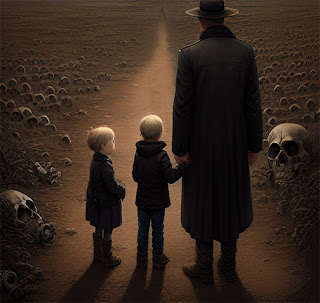
Every day I listen to (or even read) opinion pieces on AI art, opposing or defending.  It always reminds me of the Kipling poem.  Kipling, by the way, in this same poem, came up with quite the most interesting take on the Fall of Babel as I've seen. They builded a tower to shiver the sky and wrench the stars apart, Till the Devil grunted behind the bricks: "It's striking, but is it Art?" The stone was dropped by the quarry-side, and the idle derrick swung, While each man talked of the aims of art, and each in an alien tongue. Yes, that's right. The entire Tower of Babel was brought down by art critics. We should add a verse for today: They taught the engines brush and pen, and fed them hues and lore, And bade them paint the birth of gods, and build new myths once more. And some cried, “Cold!” and others, “Cool!”—and argued from the heart. While the Devil prompted them,  “It’s AI… but is it Art?”

Update on The Unfinished Song

It's not unreasonable to assume that anything which has taken too long already will never be completed at all. This is certainly the point of view of my children regarding my progress on my main series The Unfinished Song. I can see their point of view; after all, I've been working on this story for longer than they've been alive. They have cheerfully told me that they expect the completion of my epic around the same year we establish a colony on Mars. A colleague of mine also used me as an example of what NOT to do as a writer. She explained that I'd taken so long to finish my series, that although I'd had an audience once, it had frittered away and no one was interested any more. Despite that, the greatest journey is finished only step after step, whether the steps are slow or not, and whether or not the traveller becomes frequently lost or lodged for a long time elsewhere. So although I've also started (and yes, even completed) other series since I started Th...

Are People Reading Less? Are we all morons now?

Have we become a morass of ignorant, illiterate morons?  For most people this question would be a no-brainer (forgive the pun),  Book reading overall is supposedly in decline, but does that mean? Less than half of US adults read even a book a year (48% in 2022 rather than 54% in 2012), according to one survey, reported in Publisher’s Weekly. (Link:  https://www.publishersweekly.com/pw/newsbrief/index.html?record=4377  ) But, weirdly, that  isn’t necessarily because fewer people are reading at all. The raw number of those who read at all seems to be stable. The problem is that Whales have become Less Whaley. What I mean is that among readers, some are Whales and some are Minnows. If you read one piddling book a year, sorry, Minnows. If you read 15, you’re a Whale. If you read a book a week, I love you. The Whales getting less Whaley means that fewer people read more than 10 books per year, dropping from 35% in 2016 to 27% in 2021 . Americans read an average of 12...

Misque Press

 My publisher Misque Press has a new website.  Although I don’t have time for blogging much, I’m going to leave this blog up (oddly, it gets a fair amount of traffic) but I’m like to direct anyone interested in my books over to Misque Press .

Who Obsesses Over Rome...

Image
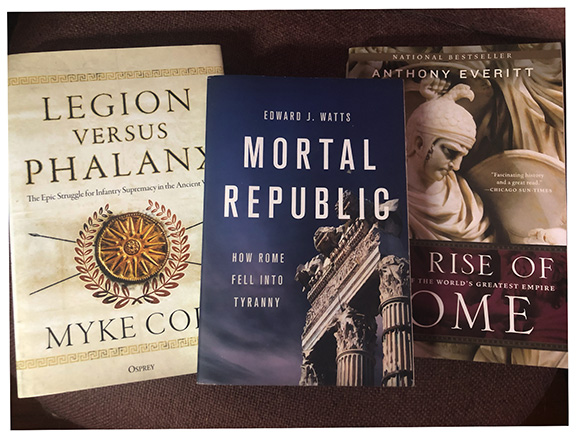
  Have you heard the latest meme going around, in which girlfriends and wives ask their romantic partners how often they think about Rome... and are shocked by the answers! Bizarrely, a lot of guys think about Rome once or twice a month, or a week, or even multiple times in a day! Which is weird, because I thought only fantasy novelists like me did that! Yeah, I do think about Rome quite often. Not so much the Roman Empire, but the Roman Republic. Why did it fall into tyranny? Are there analogies to our current situation? When did the first tyrant appear in the Roman Republic and how did his example make it easier for Caesar to take over as a permanent dictator eighty years later? (Whoops, I gave away the answer there.) And sometimes I do think about the Roman Empire too, particularly when I'm researching history's worst and craziest dictators, like Nero and Caligula, to see if I can find models for villains in my stories. And when I'm researching battle, of course, I alw...

How Does Fiction Reading Influence Empathy?

Image
  Last week, I discussed some fascinating questions regarding Empathy, Fiction and Imagination .  Those essays were theoretical, not empirical. I thought it would be interesting to see if there is any empirical evidence that reading fiction increases one's empathy or kindness. (What the lab shrinks like to call "prosocial behavior," as opposed to "anti-social behavior.")  I found a plethora of evidence that it does. Am I surprised? Not at all. I could have guessed as much based on the reading habits (or lack) of people I know. But of course, anecdotes aren't scientific, even if they do provide for pretty good "rules of thumb." Science reported in 2013 on a study done by Kidd and Castano that reading fiction increases one's ability to " comprehend that other people hold beliefs and desires and that these may differ from one's own beliefs and desires." In other words, reading fiction improves your "theory of mind": your i...

Empathy, Fiction and Imagination

Image
  Empathy is the ability to understand and share the feelings of others. Where does empathy come from? How did empathy evolve? Why can we "feel" for fictional characters? These are some of the questions explored in a collection of papers on Empathy, Fiction, and Imagination . Many people associate empathy with being social, yet it can't be that simple. Ants, bees, and termites are so social we had to coin a special term for it: eusocial . Yet it is not empathy that drives their sociality, but pheromones, castes, and a simple set of rules that each ant follows depending on its birth order and age in the colony. Nonetheless, most "theories of mind" to explain empathy assume that we evolved the ability to model each other's minds because we need to understand each other. We have "mirror" neurons which enable us to copy each other.  In most models of empathy, it is assumed that empathy evolved to facilitate reciprocal altruism. Direct Perception Theor...

Movie Review: Dungeons & Dragons

Image
  Growing up I always wished there were more Fantasy movies. Lately, I've ammended the wish: what I want is more GOOD Fantasy movies. There have been some truly awful Fantasy movies lately, which made the world a worse place. I don't review those because I prefer to focus on what's done right than what's done wrong. Having been burned, I was cautious about Dungeons & Dragons: Honor Among Thieves. I could see it was "irreverent and witty" but sometimes that translates into "mocking the fans and not taking the story seriously." I'm happy to say that Dungeons & Dragons: Honor Among Thieves was funny, yet still took the source material seriously. My sons and I watched the movie at home so we could pour over our D&D manuals as we watched, finding the character types and monster types and spells referenced in the movie. There were plenty--this was fan service done right.  You can still enjoy this even if you are a D&D fan! Given all the...

Birthgap - That Feeling of Deferment

Image
  My previous post on the Birthgap focused on (potential) mothers, but these issues bother (potential) fathers as well.  I think this post, " Invisible Hands: The Anxiety of the Childless," captures the conflict between the urge to wait until things are "stable" before having children, and the creeping anxiety that you could wait... until it's too late. In the dark and heat of the present moment, all of this might seem obscure. But take a breath, and it becomes quite clear. To put it simply, for some years now, I believe I have been suffering from the anxiety that I might never have children. Of course, this anxiety is not the brute, biological force of the female. Rather, it is the nervous and blithering practical rationalism of the male. Which for me, a nervous and blithering poetical songwriter, is often expressed in lyrical thoughts. If I were to put an image to this feeling, the first that comes to mind is apposite but crude: it is the image of a baby, st...

Whoah! Hold Your Horses--ChatGPT is not Conscious, Argues These Dudes

Image
  Omigud! ChatGPT is in love with me! General AI is here! Robots are rebelling and computers are taking over the world! Whoah, partner, hold on, warns these dudes. Not so fast. ChatGPT ain't even as smart as my horse, never mind as the town Sheriff. (Gratuitous and irrelevant plug: you can read a paranormal romance about a small town Sheriff right here.) There are many language models out there that can process language just as well (seemingly) as humans do. I've spoken about them before and even wrote a book about how to use them in creative writing. They're called Large Language Models (LLMs) and they're getting better and better every day. Some examples include GPT-3, BLOOM, LaMDA, and OPT. These models use a lot of data to understand language and can do things like answer questions or generate text. While LLMs are sometimes grouped together, each model is unique and may use additional methods to alter its results. Some researchers refer to LLMs as "foundational...

Wednesday Writing: Rereading a Novel Like a Poem

Image
  A novel is not a poem. But in a sense, a novel is a poem, if a poem could be as long as a book, or even as long as a series of books.  All of the old books, of course, began as poems. But that was in the days when every poem was a song and many people didn’t take in the story with eyes, but with ears and tongues. The Shanamah , a Persian epic I wrote about for my senior thesis in history, for my BA, was nine volumes of poetry. I am sorry to say I was not able to read it in the original Persian. I read a turn of the 20th century translation in English couplets. Reading nine volumes of couplets becomes wearisome, which is why novels are not written in couplets. Of course, most contemporary poets, sneer at something so prosaic as a rhyme in a poem. Rhymes are out of fashion. Perhaps poems have become envious of novels, with the spacious longitude and latitude of their prose.  But I occasionally become envious of the old poets, those who rhymed, and occasionally I sneak rhy...

Is a Story like a Road or a House?

Image
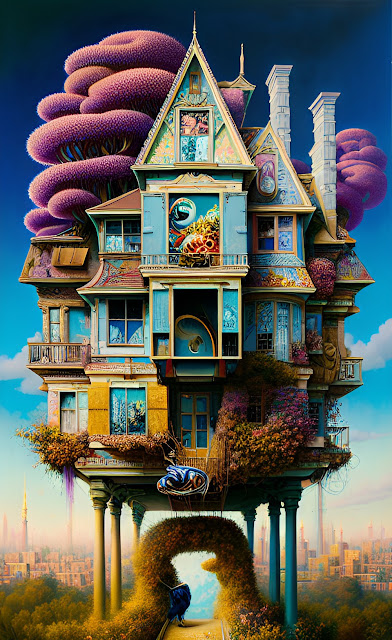
“A story is not like a road to follow … it's more like a house.  You go inside and stay there for a while, wandering back and forth and settling where you like and discovering how the room and corridors relate to each other, how the world outside is altered by being viewed from these windows. And you, the visitor, the reader, are altered as well by being in this enclosed space, whether it is ample and easy or full of crooked turns, or sparsely or opulently furnished.  You can go back again and again, and the house, the story, always contains more than you saw the last time. It also has a sturdy sense of itself of being built out of its own necessity, not just to shelter or beguile you.” ―  Alice Munro,  Selected Stories Is a story a road or a house?  I love this quote by Alice Munro, and the languid, cozy imagery of a story full of rooms and windows, where you can visit or even live. That doesn't mean I agree with it completely. Some stories--perhaps most storie...

The Birthgap

Image
   First, the good news. In a recent study titled "Women's empowerment and fertility: A review of the literature," Ushma D. Upadhyay and colleagues examined the relationship between women's empowerment and fertility. With women's empowerment becoming a focal point for development efforts worldwide, the researchers conducted a critical assessment of the existing evidence on this topic. The review analyzed 60 studies, with the majority of them (n=35) conducted in South Asia and using household decision-making as a measure of empowerment (n=37). The results showed that the majority of the studies found when women are embowered they have fewer children with longer spacing between births, and lower rates of unintended pregnancy.  The findings suggest that when women have more decision-making power in their households, it has a strong impact on the number of children born.  This underscores the importance of empowering women and ensuring that they have access to the res...