Posts

Showing posts with the label dialogue

Writing Craft: Body Language in Dialogue Scenes

Image
A guest post from Rayne Hall.  Body language can add another dimension to your dialogue scene, because it reveals a person's intentions, feelings or mood. The five main types of body language are gesture, posture, movement, facial expression and tone of voice. Gesture Examples She pointed to the orchard. “I saw him there.” He slammed his fist on the table. “I've had enough.” She scratched her chin. “Are you sure this will work?” “Welcome.” He pointed to the couch. “Why don't you make yourself comfortable?” Posture Examples She raised her chin. “You can't make me do this.” He locked his arms across his chest. “No way.” She leant away from him. “This isn't working between us.” “I consider this an insult.” He stood with his shoulders squared and his legs braced. “Take it back.” Movement Examples “Maybe another time.” He turned to leave. She walked faster. “I told you I don't want a date.” “All right.” He shuffled forward. “Follow me!” She ...

Three Ways To Do Dialogue Attributes Wrong

Image
One of the first novels I wrote, 
when I was, ye gods, twelve or thirteen, I don't remember (or I have 
thankfully blanked the memory from my brain) was Star Trek 
fanfic. On the first draft, the dialogue looked something like this: "Maybe the attacker was a Klingon," said Kirk. "That is not logical, Captain," said Spock. "But he looked like a Klingon," said Kirk. "But then he turned into a furry white snow monster," said Spock.
 "That's what puzzles me," said Kirk. And so on. image: Marc Wathieu Well, neophyte though I was, even I could tell that was 
terrible dialogue. (And it tended to go on for three pages). But why, WHY did it suck rocks? That's what I needed to pin down. Probably 
because so much was wrong, I settled on the most obvious (to me) 
problem, the boring repetition of "said."

How to Convey Subtext in Dialogue - Part 2

Image
"I think you've mistaken me for someone else. I'm not that man." Subtext is the art of saying the unsaid and thinking the unthinkable. There are several techniques that authors use to convey this. Among others: 1. Secret dialogue. 2. Actions speak louder than words. 3. Catch phrase or repetition. In this post, I'll discuss the first, possibly most common technique, secret dialogue. Secret Dialogue In the Fever series , by Karen Marie Moning , feisty heroine Mac and sexy antihero Jericho Barrons have to work together to defeat the Unseelie before they take over the world, starting with Dublin. Unfortunately, they don't trust each other--and they don't communicate very well. At least not openly. They have whole "non-conversations" however, through silent understandings, exchanged through glances and conveyed to the reader through italics. This one is from Faefever , the third book: We looked at each other and for a moment those ...

How To Convey Subtext in Dialogue - Part 1

Image
Updated May 16, 2022 We all live in a Yellow Obmarine. Subtext in dialogue is the opposite of the obvious; it's dialogue in which what goes unsaid is as important as what is said. The opposite of this is not, but should be, called obtext . Screenwriters have a term for dialogue in which characters say exactly what they mean: "on the nose." I'll stick with obtext. Sad to say, obtextual dialogue, one obvious and true statement after another, usually sounds unrealistic, because people seldom say exactly what they mean, or all of what they mean. There are two places you can see obtext used to good effect: children's stories and comedy. In children's stories, characters say exactly what they mean, because this is what children themselves do. That's why they walk up to the obese woman and ask, "Why are you so fat?" or ask the man with long hair, "Are you a daddy or a mommy?" or comment on their baby brother's drawing, "It...

Seducers, Charmers and Con Men

Image
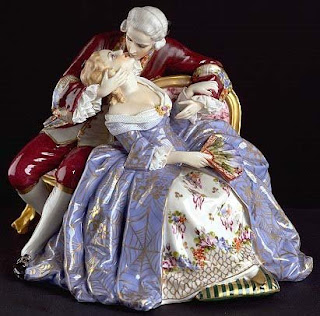
Candice Kennington has a post wondering if it is possible to make one's villains too charming -- stealing the hero's thunder and the reader's heart. This made me cogitate. (It's my blog. I can use pointless $3 words if I want!) In Book 2, the heroine has three potential love interests. Hero - Her first love, who (she thinks) abandoned her, but who was actually removed by the villain. I don’t want her first love to seem like a wanker or a wimp even though he’s out of the picture. Anti-hero - The villain who falls for the heroine himself though his feelings for her endanger his nefarious schemes. I want the the villain to be the dark, brooding type you fall in love with, even though you know it’s not a good idea. Foil - The charmer who accepts a Dangerous Liaisons type challenge from a villainess to seduce the heroine. I want the charmer to be another kind of bad boy to make the villain/anti-hero seem ironically gallant by comparison. (I.e. the villain may be serving...