Posts

Novels vs Poems, Integrity of Language

I've found a great way to come up with ideas for new blog posts is to just steal them from The Literary Lab and I've done that again. This post of theirs on revising has been percolating through my mind for some time now: I consulted a poet friend that I have mentioned once or twice here before. His name is Craig Cotter, and over dinner I asked him why he made certain word choices or phrase constructions in several of his poems.... What I realized was that Craig had initially limited himself to what edits he was allowed to make. The source of his inspiration, the motivation that got him to write this poem in the first place, he felt, was preserved in that first draft, not in the idea of that first draft. That meant that he couldn't revise everything. He couldn't start from scratch with the same idea, because that would be a different poem--one that he could write at a different time. My gut reaction reading this was to think, "But prose is different from poetry. ...

Uneven Writing Quality

Even though I am not going to look at it again until I have heard back from my beta readers, I already know one problem with my wip is uneven prose. The first chapters and the last chapter are colored, curled and styled to a chic finish, whereas middle chapters look like a hair-cut by an ax. Even beta readers tend to gloss more over the middle than the beginning, as they suffer from crit fatigue. Does anyone else have this problem? Any solutions or tips?

Between Old and New

I haven't started writing yet on my Secret Novel (research continues) and I've forbidden myself from even looking at Dindi until I finish writing my critiques for my Beta partners and receive their crits on Dindi in turn. This leaves me with nothing to write or revise and I'm starting to get antsy. I've even -- deities help me -- taken to doing house work ! (Desperate times indeed.)

Why Character Driven Fiction Can Be Subtle

Image
I'm still at the research stage of my Secret Novel. I'm entering new territory with this novel. Dare I say it is literary? Perhaps -- I've concluded after spying on the discussion over at The Literary Lab -- not. Although the period of my piece is fairly contemporary, I see it as historical fiction. Some historical fiction is undoubtedly literary, but some must be mainstream. A definition to distinguish the two has been put forth: "what distinguishes literary fiction is what is left unsaid. Narrators may be self-absorbed or unreliable, things are pointed to without being explained." It is what happens "between the lines." Thinking about a historical novel like The Source by James Michener, I wondered if what happens is between the lines. I decided, not really. The themes are deep and mind-blowing, almost incomprehensible, despite being stated as explicitly as possible. I think most literary stories are character-focused and the game is all about inferri...

Choosing a Character who Sees Deeply

I really want to reveal the nature of my secret novel, before I make it so mysterious that it becomes a let down when I finally do reveal it. That said, I'm not ready to talk details yet. As Scott Bailey mentioned in the comments on his blog post about outlining, it's not so much because I'm trying to keep it secret as that I don't feel comfortable jinxing it before I have a draft. So, for now, it's still the secret novel. That said, I'll still discuss a problem in general terms, if I may. That's choosing a character who can see deeply. I have several characters already chosen for me, as it were, by the nature of the novel. I know who my four main pov characters must be, at least in broad strokes. I still have to make sure, however, that the personality of these characters is not only sympathetic enough to justify being a protagonist, but profound enough to have insights into their own situations. This is tricky. I don't want the characters to be a mer...

Running Out Of Future

Image
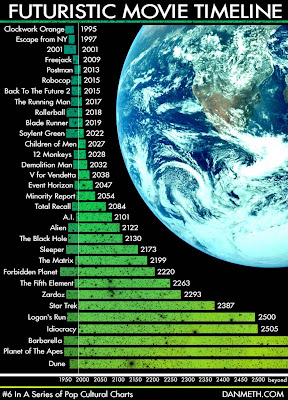
Uh oh, is science fiction running out of future? 1984? 1999? 2001? 2010... Are all the "cool dates" taken?!

RWA vs Epublishers

An interesting confrontation between the RWA and the world of epublishing, defended here by agent and author Deidre Knight. RWA’s current stance on e-books is that a publisher must offer at least a $1,000 advance in order to qualify for legitimacy. Never mind that many digital authors far exceed that amount in royalties, or sell more than 5,000 copies of print editions of their e-published titles. The problem with RWA’s simplistic criteria is that it ignores one crucial fact. Our industry is changing radically, with traditional publishers seeking innovative models for overhauling their distribution and content. ... Meanwhile, let’s talk about RWA’s position that e-published authors who make more than $1,000 in royalties are a rare exception. As an agent, I have seen a fair number of statements for clients writing for Ellora’s Cave and Samhain. The majority of these writers have passed that $1,000 benchmark within the first few months. I’m sure some of the smaller e-publishers sell...